
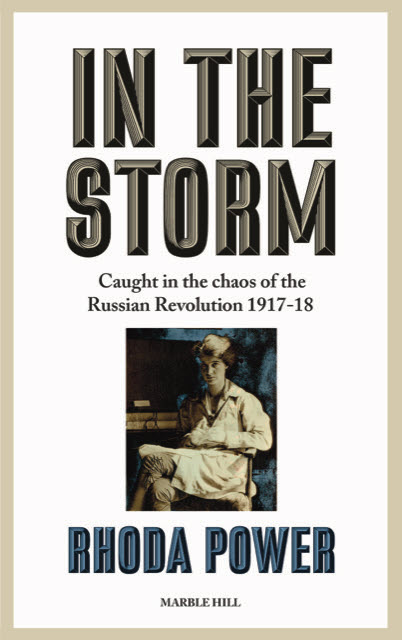
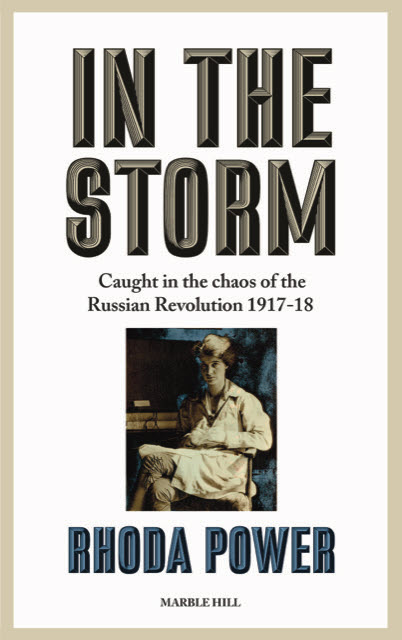
In the Storm: Caught in the chaos of the Russian Revolution 1917-18
Product Details
- Format:
- Paperback
- ISBN:
- 9781068360855
- Published:
- 9th Oct 2025
- Publisher:
- Marble Hill Publishers
- Dimensions:
- 166 pages -
- Categories:
Product Description
In the Storm
December 1916. A young English woman crosses a North Sea patrolled by German submarines on the first stage of her lengthy journey to the Southern Russian city of Rostov-on-Don where she is engaged as a tutor to the teenage daughter of a prosperous industrialist. Within three months the Russian Revolution explodes, and she is caught up in chaotic and bloody months of violence.
Rhoda Power’s remarkable record describes with an extraordinary cool eye - and often humorous ear – her growing sense of insecurity and powerlessness as the conventions and divisions of the social order are swept aside in a tumultuous outpouring of repressed resentment, prejudice, vengeful lawlessness, terror and murder. The shell fire and machine-gun bullets of the Battle of Rostov become the soundtrack of her daily life. Death is all around. And the Germans are advancing.
Originally published in 1919 as Under Cossack and Bolshevik Rhoda Power’s account of an ordered existence degenerating into battles raging in the streets around her and of her perilous escape is a neglected classic of outstanding “on the ground ” reporting of events at a time when morality and justice no longer exist. Her words bring home the courage of a remarkable woman; although written over 100 years ago, they have a remarkable contemporary resonance and relevance in today’s turbulent world of conflict.
- A remarkable personal report of a world without law and morality.
- A rediscovered account of daily life in a revolution by a pioneer of BBC schools broadcasting.
The story behind
It is extraordinary how sometimes the past can come racing back into the present, recovering memories long buried. This happened to me when recently I was offered a copy of a book originally published in 1919 entitled Under Cossack and Bolshevik. I had never heard of it - but I recognised at once the author’s name. Why? Because along with many thousands of other schoolchildren, I listened spellbound to wonderful dramatisations of historical events on the BBC - all written by Rhoda Power.
I hadn’t thought about Rhoda Power for more decades than I care to reveal. I knew she had written children’s books (I still, have a copy of Redcap Runs Away). Why, I wondered, should I republish a book Rhoda that had first engaged readers so long ago. What was its relevance today? Then I read it - and knew at once why I had to.
By any test, the retitled In The Storm is an astonishingly modern and vivid first-hand report of one woman’s experiences of the brutal Russian Revolution that overwhelmed Rostov-on-Don where she was tutoring the daughter of a rich merchant.
Her theme, which could not be more apposite today, is what happens when the rules and structures that enable us to live together - all the essential elements we rely on, laws, utilities, social order - are suddenly stripped away and replaced with chaos where nothing works except for the machine guns, the violence and the threats that surround you. How do you cope?
Rhoda Power’s remarkable book, brought to me by her godson, Basil Postan, is an astonishing graphic account of what revolution is like. In a word, it is terrifying - and more so when you are a stranger is a land that is exploding around you. This story of a young woman’s experiences of revolution and her hazardous escape is a book that deserves to be recognised for the classic it is.
Francis Bennett
Reviews
In the Storm: Caught in the Chaos of the Russian Revolution 1917-18 Rhoda Power reviewed by Lynn Barber/The Spectator
This vivid account of a young English-woman caught up in the Russian Revolution was first published in 1919 as Under Cossack and Bolshevik, but it’s possibly even more gripping today. Rhoda Power, a political science graduate, was 26 when she was hired as a tutor to a 16-year-old Russian girl, Natasha Sabaroff, living in Rostov-on-Don. Going to Russia had for years been one of her dreams, so off she sailed from Newcastle to Bergen through U-boat-infested seas; and, indeed, future sailings were cancelled after four ships were torpedoed. But she arrived safely in Bergen, where the Cook’s man put her on a train to Petrograd (St Petersburg), which she spent four happy days exploring before taking the three-day train journey on to Rostov.
Her employers, the Sabaroffs, were one of the two richest families in the city and lived in a grand mansion with many servants. They feasted and went to the theatre in their carriage wearing jewellery and furs while their servants worked all day and slept on the floor. Rhoda writes: ‘I was very sorry for the servants, they had such uncomfortable lives, and though they nearly all seemed to be thieves and liars, I could not help liking them.’ Her pupil, Natasha, treated them with contempt – ‘they are all pigs’– but Rhoda wasn’t that smitten by Natasha either. The girl had no interest in learning and paid a teacher to write her essays. Her one ambition was to get married. But she told Rhoda: ‘You will always be funny and English, so you will never be married.’ (This turned out to be true. Rhoda never married but became a pioneering children’s broadcaster and died in l957.)
She was constantly struck by the huge gulf between the Sabaroffs’ ostentatiously luxurious life and the peasants who had to wait in bread queues throughout the night: ‘I used to wonder how long it would be before they would rebel.’ She noticed one particular girl, Anna Ivanova, who worked in a factory all day and then joined the bread queue, getting weaker and thinner, until one day she didn’t appear and Rhoda heard that she had died. She also observed soldiers leaving for the Front with their boots falling apart and sometimes only one rifle between five men. ‘The country was literally worn out.’
‘And then the Revolution came.’ For three days there were no trains and thus no news from Petrograd; but rumours flew around and then a messenger came from the station: ‘In less than half an hour the whole town knew that the Tsar had abdicated and that the students and workmen were fighting against the police in the streets of Petrograd.’
Rostov remained orderly but red flags started appearing and people began to organise public meetings, which had hitherto been illegal: ‘The police, like the Snark-hunter, “softly and silently vanished away”. In any case, they had no power, for they were deprived of their firearms, and the people simply refused to recognise them.’
The Sabaroffs’ servants attended meetings at which they resolved to work only eight hours a day; and when the coachman and chauffeur failed to turn up to take the family to the theatre, the only explanation given was ‘Cvoboda’ (liberty). Anyhow, ‘the car and carriage, not to mention the horse, were missing’. Home life became completely disorganised: ‘Servants who wished to go to the cinema sauntered out of the house when they pleased; workmen, bored with what they were doing, temporarily downed tools and strolled off to meet their friends.’
The Sabaroffs decamped to their dacha near Odessa for the summer and spent their time giving tea parties for their friends. But when they returned to Rostov they found the situation had grown far more dangerous. The price of food had increased seven times, and the news from the Front was uniformly bad. More-over, all prisoners had been released and formed themselves into rival gangs – the Union of ex-Criminals, the Society of the Red Hand, the Committee of Adventurers and Apaches – who went around extorting protection money. M. Sabaroff received a note from the Apaches demanding 15,000 roubles to prevent his house from being bombed.
So the Sabaroffs decided to move to their flat in Novocherkask to the north of Rostov, leaving Rhoda and Fraulein (Natasha’s German tutor) alone in the house, saying that, being foreigners, they had nothing to fear. In fact they had plenty to fear as gangs of brigands roamed the streets but Rhoda found her way to the British consulate, where she stayed while the Bolsheviks and then the Anarchists took over the city. The Anarchists, Rhoda writes, were ‘like children playing at brigands with real firearms’.
Meanwhile, the Germans were advancing and Rhoda determined to leave Rostov on a refugee train. It had no water or food, and took 12 days to reach Moscow, where she stayed for three days before joining another refugee train to Murmansk. By now the passengers were no longer in danger from the Germans and they grew wildly hilarious and gave nightly concerts; but in Murmansk they were put in a grim barracks with bed bugs and many fell ill with smallpox or Spanish flu. Then followed 17 days by ship to Britain, where Rhoda arrived three months after she’d set out from Rostov.
The great thing about her is that she is an utterly trustworthy and sharp-eyed observer who simply reports what she sees without moralising. She is brave, resourceful, cheerful and never given to self-pity. The one time she almost breaks down is when she watches a Bolshevik funeral procession and realises that the coffins are uncovered, so she can see limbless trunks, heads severed from bodies and crushed faces: ‘All the while there was a sickening odour of putrefaction.’
The book has an excellent introduction by Rhoda’s godson Basil Postan, and a helpful glossary and chronology. I could have done with a map showing where the German front was at various times and perhaps more explanation of the different armies – Reds, Whites, Junkers, Anarchists, Cossacks, Volunteers – that passed through Rostov. But as a vivid eye-witness account of a turbulent time, In the Storm is really unsurpassed.
Lynn Barber is a former Sunday Times journalist and author of An Education and A Curious Career.